Invisible Ink Easy Hands-On Science Activity
My kids love hands-on activities, but science usually takes a large amount of prep and materials.
We did this activity to go along with our French unit study when we learned about Marie Curie.
You can do this activity with materials you already have in your house!
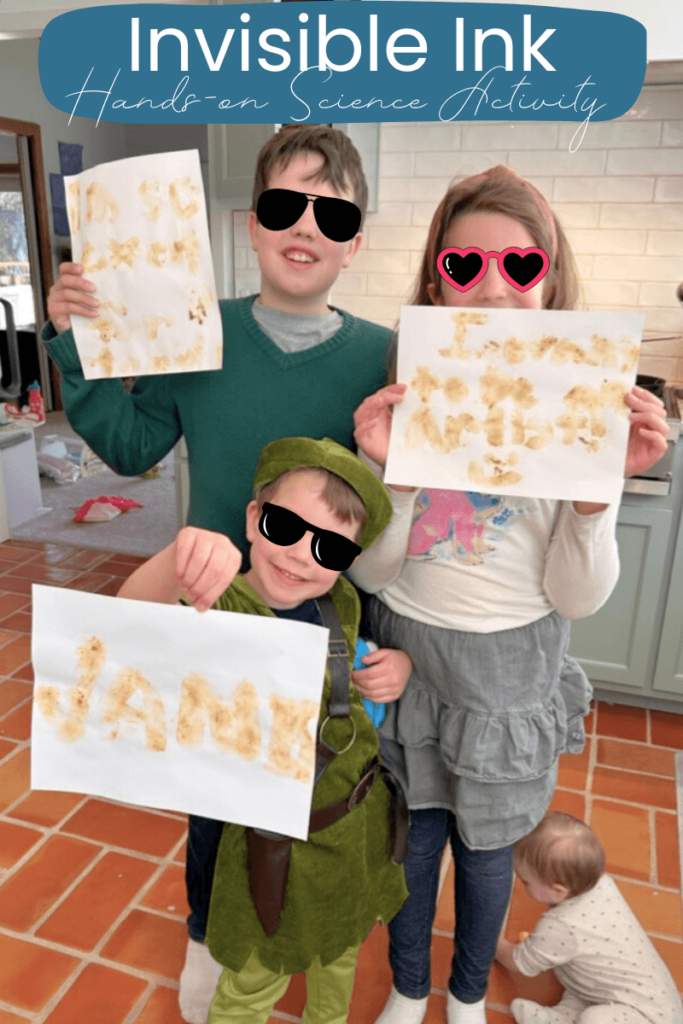
Materials Needed
- White paper
- Cotton balls or Q-tips
- Lemon juice
- Blowdryer, Iron, or Candle
Instructions
- Gather materials. Squeeze the juice of one lemon into a bowl.
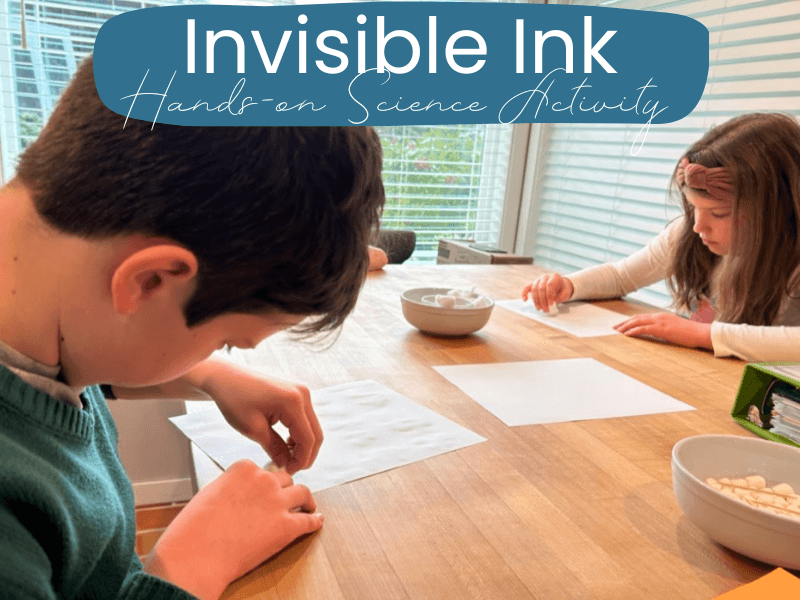
- Dip a cotton ball or Q-tip into the lemon juice and write a secret message on the paper.
- Let the paper dry for a few minutes (about 2-5 minutes).
- Heat up the invisible ink by placing the paper. Using one of these three methods:
- Blowdryer method: Use a blowdryer on high heat over the secret ink until the letters appear.
- Iron method: Place paper on top of a towel to protect your table or ironing board. Run the hot iron over the paper back and forth until the message appears.
- Candle method: Carefully hold the paper over a candle (be careful not to catch the paper on fire) until the message appears.
- Enjoy your creation! And discuss why this chemical reaction takes place.
The Science Behind This Invisible Ink Activity
This chemical reaction is caused by the sugars in the lemon juice caramelizing in what is known as the “maillard reaction”.
The maillard reaction is what is responsible for the golden brown color of cookies and the beautiful brown crust on your favorite bread.
The sugars heat up and turn brown to reveal the writing.
Alternatives to Lemon Juice
If you don’t have lemon juice, you could use sugar water.
Sugar water works but it will leave a sheen where you’ve written which takes away the “invisible” aspect.
Make sure to use white sugar, not brown.
What Learning Objectives are Met?
🔬 Science Learning Objectives
- Scientific Practices & Inquiry
- Ask questions and make predictions based on observations.
- Plan and carry out a simple investigation.
- Make observations and record data to help explain the outcome.
- Communicate findings using evidence.
- Physical Science (Chemistry Concepts)
- Understand that materials can undergo physical and chemical changes.
- Identify that some changes to materials (like lemon juice turning brown with heat) are irreversible.
- Explore how heat can cause chemical reactions.
- Matter and Its Interactions (NGSS PS1.A & PS1.B)
- NGSS PS1.A: Structure and Properties of Matter – Observe that materials have different properties.
- NGSS PS1.B: Chemical Reactions – Describe how substances can change when combined with others or when exposed to energy (like heat).
✍️ Cross-Curricular Literacy/Language Arts
- Follow multi-step directions in a procedure (how-to writing).
- Use scientific vocabulary to explain a process.
- Write and present observations or conclusions.
- Practice clear communication and explanations.
🎨 Creative/Art Integration (Optional Extensions)
- Use invisible ink as a form of secret writing or artistic expression.
- Understand how science can be used in creative problem-solving.
🧠 Critical Thinking & Reasoning
- Make connections between cause and effect.
- Compare results from different methods (e.g., lemon juice vs. milk or vinegar as invisible ink).
- Form hypotheses and test them through repeated trials.
👥 Social-Emotional Learning / Collaboration
- Work cooperatively in small groups or pairs.
- Practice patience while waiting for results (e.g., waiting for ink to appear).
- Build confidence through discovery and problem-solving.
This post contains affiliate links. Read my policy here.