How to Start Homeschooling Your Neurodivergent Child: 5 Simple Steps
So you’re feeling the nudge to homeschool, but you’re not sure how to get started.
Maybe you’ve been researching homeschooling online, and instead of feeling more confident, you’re feeling completely overwhelmed.
There are curriculum choices. Homeschool schedules. Morning baskets. Co-ops. Enrichment programs. Reading lists. Math programs. Homeschool rooms. And approximately a million opinions about what your homeschool should look like.
And if you’re homeschooling a neurodivergent child, you may already be wondering how you’re supposed to make any of that work when your child struggles with focus, gets overwhelmed easily, or has meltdowns.
But here’s something I want you to know:
Getting started with homeschooling your neurodivergent child can be much simpler than the internet makes it seem.
In fact, I want to encourage you to do something that may feel completely backward:
Don’t start with curriculum.
Start with your family.
Start with connection.
Start with a rhythm.
Then build from there.
1. Build a Rhythm Before You Obsess Over Curriculum
What?
Most homeschool videos and blog posts you’ll find online seem to revolve around one thing: curriculum.
What curriculum are you using?
What’s the best reading curriculum?
What math program should you choose?
What does your kindergartener need to learn?
Which science curriculum is hands-on enough?
And curriculum can certainly be helpful, but curriculum is not a foundation for your homeschool.
Your rhythm is.
Why?
Curriculum—or even enrichment programs—can be a shaky foundation because if one doesn’t work out, you have to start over.
It’s very easy to go down a curriculum rabbit trail.
You start looking for a reading program and find a phonics program.
Then you discover a handwriting program that looks great.
Then there’s a beautiful morning basket.
And a science curriculum.
And a history curriculum.
And maybe an art program.
And before you know it, you’ve created three hours of daily lessons for your kindergartener.
And every single one requires you to sit down and teach it.
Except you have two other children who need you, too.
Suddenly the beautiful homeschool you envisioned as calm and connected feels like you’re running a tiny private school out of your living room.
That’s not sustainable.
And it may not fit your vision for your homeschool at all.
How?
Instead, start by building a flexible rhythm.
Think about the anchors that already exist in your day.
These might include:
- Wake-up time
- Breakfast
- Lunch
- Nap or rest time
- Dinner
- Bedtime
Then think about what meaningful blocks you can create between those anchors.
Maybe you have a block for:
- Family learning
- Guided or independent work
- Reading aloud
- Art
- Outside time
- Recess
- Free play
- Chores
- Quiet time
You don’t have to schedule every minute.
You’re simply creating a framework that helps everyone know what generally happens next.
For example, our family has a rhythm that includes getting ready and doing chores, breakfast, family morning learning time, recess, independent work, lunch, and a quiet activity/rest period.
The exact details can change, and that’s the point. A rhythm gives your family structure without requiring you to live by the clock.
2. Build Regulation Breaks and Routines Into Your Day
If you’re homeschooling a neurodivergent child, regulation can’t be something you squeeze in after the schoolwork.
It needs to be part of the rhythm.
What?
Your child needs regular opportunities to regulate their body and nervous system throughout the day.
And so do you.
Why?
When a child is dysregulated, learning becomes much harder.
They may not be able to process or retain the information you’re teaching. They may become frustrated, shut down, refuse to participate, or eventually have a meltdown.
Sometimes what looks like a learning problem is actually a regulation problem.
So instead of constantly asking, “How do I get my child to focus?” it can be helpful to step back and ask:
“What does my child need right now?”
How?
A foundation for regulation includes the basic things we can sometimes overlook:
- Enough sleep
- Regular nutrition and snacks
- Time outside
- Physical play or exercise
- Sensory input
- Fine motor activities
- Auditory input
- Time with a parent, favorite sibling, or pet
- Opportunities for co-regulation
Sometimes the solution really is as simple as food or outside time.
In our house, I’ve learned to pay attention to patterns. If everyone suddenly becomes irritable around a certain time of day, I don’t automatically assume we’re having a behavior problem.
Sometimes everyone just needs a snack, a movement break, some time outside, or a little connection with mom or dad.
And don’t forget your own regulation.
Homeschool parents need to also focus on getting their own regulation.
Homeschooling can be incredibly overstimulating.
And homeschooling neurodivergent children can add even more layers of noise, movement, questions, emotional regulation, interruptions, and competing needs.
You need breaks, too.
These can be long daily breaks, weekly, or mini moments throughout the day: sipping a favorite drink during a time your kids are engaged in their own play or show, taking a walk around the yard to breathe deeply, etc.
For me, some of those natural breaks have been:
- Midmorning recess
- A one-hour quiet time block
- Outside play in the afternoon
- Time during extracurricular activities when I am waiting for a child and at home I have support like a babysitter or my spouse watching my other children
- And more recently, getting up early so I can have some quiet time before everyone else is awake
Don’t look at your child’s regulation needs as an inconvenience you have to fit into your school day.
Build regulation for your child into the rhythm from the beginning.
And build your own breaks into it, too.
3. Start Small and Build Slowly
What?
If you want to create a homeschool rhythm that is actually sustainable, start small.
You do not need to begin with a full school day.
You don’t even need to begin with every academic subject.
Why?
When you first start homeschooling, you’re creating trust.
You’re learning how to homeschool.
Your child is learning how homeschooling works.
And if your child has ADHD or another form of neurodivergence, too many demands introduced too quickly can easily lead to overwhelm and resistance.
This is where de-schooling can be incredibly helpful.
You don’t need to recreate the six-hour school day at home.
Remember how much time is lost during a traditional school day to transitions, lunch, passing periods, assemblies, waiting for other students, lining up, and managing an entire classroom?
You aren’t trying to reproduce all of that.
And when you’re homeschooling a neurodivergent child, you may actually need to do less academically because you’re doing more as a parent.
You’re supporting regulation.
You’re adapting instruction.
You’re helping with transitions.
You’re navigating sensory needs.
You’re managing emotional ups and downs.
You’re building relationships.
That is work, too.
How?
Start with one or two things.
Choose something your child enjoys or something that feels relatively easy.
Maybe it’s:
- Reading aloud together
- Playing math games
- Cooking
- Going outside and exploring
- A science activity
- Talking about history
- Building something
- Playing a board game
- Working on a practical life skill
Let your child experience what it feels like to learn without constantly feeling pressured.
I remember seeing this with my daughter. When she wanted to learn something because she was interested in it, there was a completely different level of engagement than when something felt forced.
That doesn’t mean we never ask our kids to do hard things.
It means we don’t have to make everything hard at the same time.
And give yourself permission for your homeschool to feel messy.
You might have planned a lesson and then ended up going on a field trip.
You might have planned to teach something and then realize that one of your children desperately needs you.
You might try to squeeze in a lesson with a child and discover that today just isn’t the day.
That’s okay.
You are not trying to recreate school at home.
You’re building an educational environment around your children and your family.
4. Make Your Homeschool Official
There’s one practical step that can’t be skipped:
Make sure you’re legally homeschooling according to the requirements where you live.
Homeschooling is a legal option in the United States, but the specific requirements vary depending on your state and the type of homeschool you’re establishing.
If your child is currently enrolled in school, you’ll also need to find out what steps are required to formally withdraw them.
How do you find out what you need to do?
Start with your state or country’s official education website and search for terms like:
“homeschooling” or “home education.”
You can also look for reputable local homeschool organizations that provide information specific to your area.
Another resource many homeschool families use is the Homeschool Legal Defense Association (HSLDA), which provides information about homeschool laws and requirements.
For example, if you’re in California, you’ll want to look specifically at California’s requirements rather than relying on a homeschool family in another state to tell you what to do.
Don’t skip this step, but don’t let it become overwhelming either.
Find out what your legal requirements are, take care of those requirements, and then move on to the parts of homeschooling that are actually about your family.
5. Define Your Why and Create a Vision for Your Homeschool
Finally, before you fill your calendar with curriculum, activities, co-ops, and extracurriculars, I want you to ask yourself:
Why am I homeschooling?
What?
You need a vision for your homeschool.
It doesn’t have to be fancy.
It can be one sentence.
It might simply be your answer to:
“Why am I doing this?”
Or maybe it’s the primary goal you have for your child or family this year.
Maybe your goal is:
- To grow closer as a family
- To help your daughter catch up in math
- To rekindle your son’s love for learning
- To give your child more time to regulate
- To create more flexibility for your family’s needs
- To provide a different learning environment
For me, having a vision has been especially important when homeschooling my own children.
Why?
Because your why becomes the filter for all the decisions you’re going to make.
If your vision is to have more time at home, help your child stay regulated, and build a more connected family, then scheduling an activity every day of the week that requires driving across town may not align with that vision.
But if your goal is to help your child develop social skills and build friendships, then driving across town every week for a co-op and attending a biweekly musical theater class might align perfectly with your vision.
Neither choice is inherently right or wrong.
The question is whether it fits your why.
Your vision can also help you when the homeschool day gets hard.
Because there will be hard days.
There will be days when the schedule falls apart.
There will be curriculum that doesn’t work.
There will be meltdowns.
There will be days when you wonder if you know what you’re doing.
On those days, your why becomes the candle you look toward in the dark.
It reminds you why you started in the first place.
You Don’t Have to Figure It All Out at Once
If you’re standing at the beginning of your homeschool journey and feeling completely overwhelmed, I want you to know that you don’t have to have it all figured out.
You don’t need the perfect curriculum.
You don’t need a perfect schedule.
You don’t need a Pinterest-worthy homeschool room.
And you don’t need to know exactly what you’re going to do five years from now.
Start with your family.
Start with connection.
Start with a rhythm.
Build in regulation.
Start small.
Take care of the legal requirements.
And define the why that will guide your decisions.
Then build from there.
Your homeschool is not going to look like everyone else’s.
And that’s okay.
You don’t have to homeschool like everyone else.
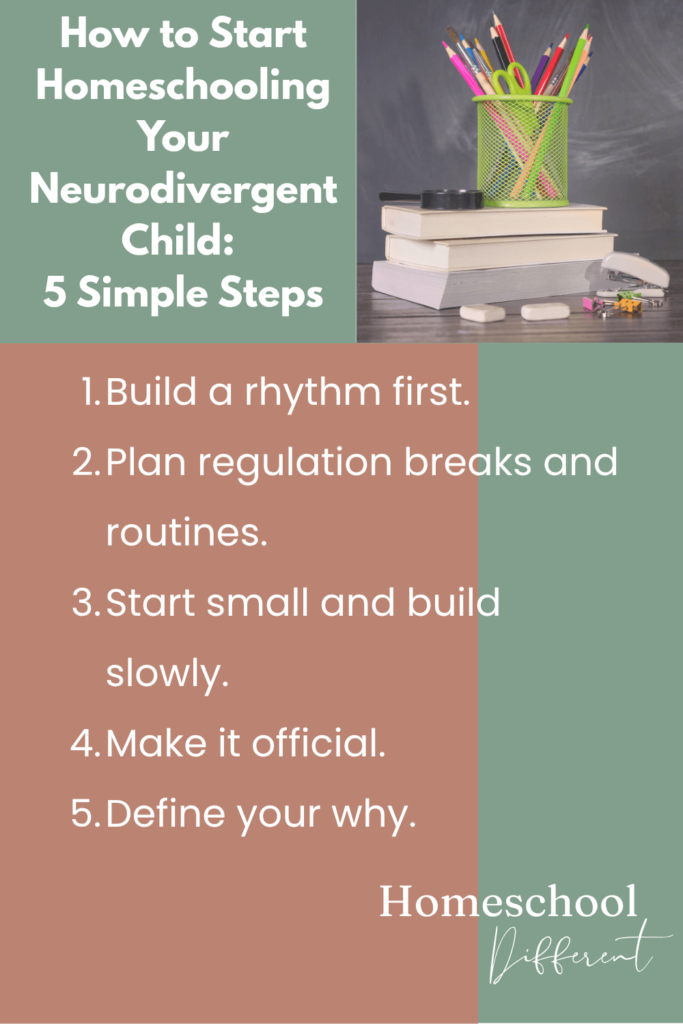
Summing it Up: The 5 Steps to Get Started Homeschooling Your Neurodivergent Child
If you want the short version, here it is:
- Build a rhythm first. Don’t make curriculum the foundation of your homeschool.
- Plan regulation breaks and routines. Your child’s regulation—and your own—needs to be part of the rhythm.
- Start small and build slowly. You don’t need to recreate a traditional six-hour school day.
- Make it official. Find out and follow the homeschool requirements where you live.
- Define your why. Let your vision guide your schedule, curriculum, activities, and decisions.
Homeschooling a neurodivergent child may not always be easy.
But it doesn’t have to be as complicated as the internet makes it seem.
Take a deep breath.
You can start small.
Listen to the full podcast episode here: