Why I Don’t Clean During Homeschool Time (And How It Helps My Kids Focus)
Every day at 2 o’clock, we start our daily quiet time.
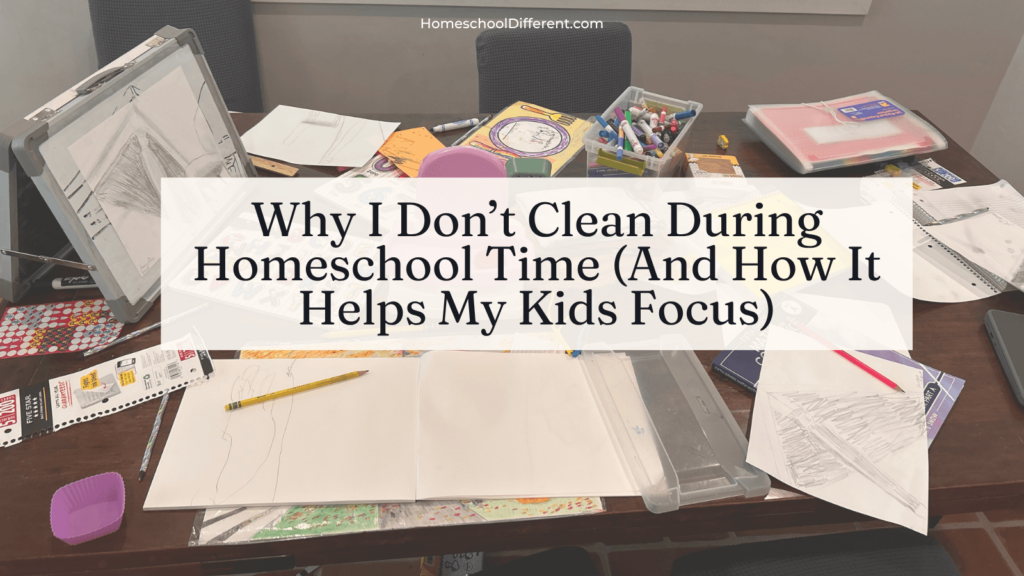
And if you walked into my house at 2 o’clock, you might wonder what in the world happened.
There is stuff everywhere.
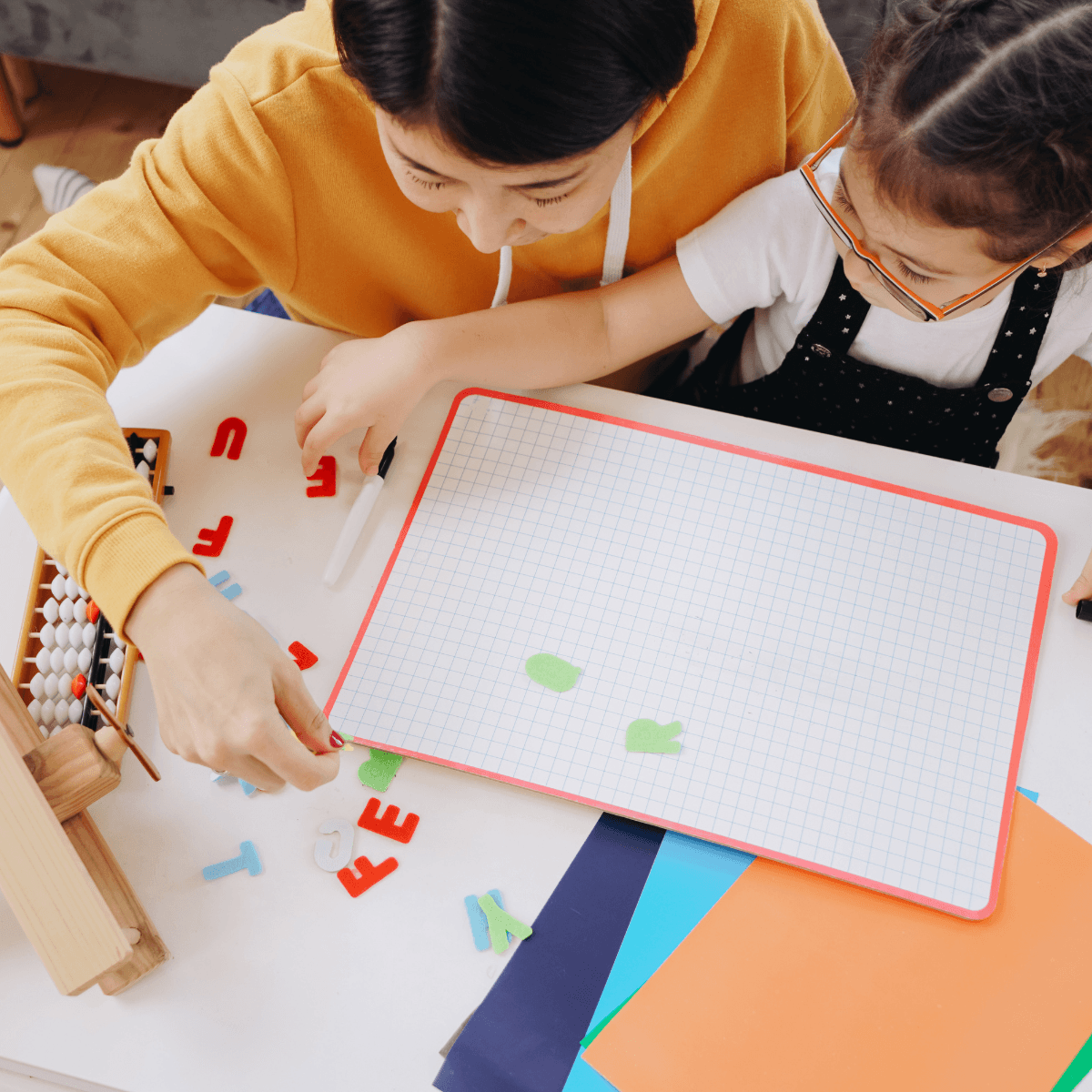
After a morning of directed homeschooling and lunchtime, toys are scattered across pretty much every room. Books are out. Projects are unfinished. There are dishes. There are shoes. There is usually some random object sitting somewhere it definitely does not belong.
It is a disaster.
And you know what?
It will get cleaned up.
But I’ve learned that there is a reason I don’t start cleaning and tidying during our school time—even when the mess is staring me right in the face.
Because protecting our homeschool time is one of the ways I protect my kids’ ability to focus.
Want to put this into practice? Get the free download:
Prefer to listen? Listen to the related podcast below
The problem with trying to do everything at once
When you’re homeschooling, there are approximately 47 things competing for your attention at any given moment.
Someone needs help with math.
Someone is hungry.
Someone can’t find their pencil.
The toddler is getting into something.
There’s laundry that needs to be moved.
The kitchen needs to be cleaned.
The living room looks like a toy store exploded.
And then there’s the schoolwork you’re actually trying to accomplish.
It can be really tempting to think, I’ll just quickly clean this up while they’re working.
Or:
I’ll just put these things away.
I’ll just start the dishwasher.
I’ll just take care of this one thing.
But I’ve found that those little interruptions aren’t actually little.
When I start cleaning during school time, three things tend to happen.
1. I’m communicating that learning isn’t as important as cleaning.
I don’t mean that my kids consciously think, Mom thinks cleaning is more important than school.
But our actions communicate priorities.
If we’re in the middle of school and I suddenly stop what we’re doing to clean the kitchen, pick up toys, answer a message, or deal with something else around the house, I’m sending the message that what we’re doing can be interrupted for whatever else happens to demand my attention.
And sometimes, school really can wait.
But sometimes it doesn’t need to.
Homeschooling deserves protected time, too.
2. My kids wander.
This is especially important in our home because some of my kids have a harder time with attention, transitions, and executive functioning.
When I get up, they get up.
When I walk into another room, suddenly someone needs something from that room.
Then someone notices a toy.
Someone starts talking to a sibling.
Someone remembers something completely unrelated.
And suddenly the child who was sitting there working is no longer working.
The whole environment has shifted.
3. The homeschool day gets longer.
And this is the part that can become a vicious cycle.
We get distracted.
Then we have to redirect.
Then we have to backtrack.
Then we lose momentum.
And eventually, something that should have taken 20 minutes has taken 45 minutes.
Then we’re still doing school at 2:00.
Or 3:00.
Or 4:00.
And everybody is tired.
The problem wasn’t necessarily that my child couldn’t focus.
Sometimes I hadn’t protected the conditions that made focusing possible.
Protecting school time is a focus strategy
When we talk about helping kids with ADHD, autism, or other learning challenges focus, we often immediately look for something we can change about the child.
What strategy can I teach?
What tool can I buy?
What visual schedule can I make?
What reward system can I use?
Those things can absolutely be helpful.
But sometimes one of the most effective strategies is much simpler:
Remove the distractions—including our own distractions.
Homeschooling takes a lot of time, intentionality, and emotional energy.
And when you’re homeschooling children with ADHD, autism, dyslexia, or other learning differences, you may be putting even more energy into helping your child regulate, transition, understand directions, initiate tasks, and stay engaged.
That means we need to protect our energy, too.
We need to protect the time we have together so that our kids get the best of our attention—not whatever is left over after we’ve tried to manage everything else.
This doesn’t mean my house stays clean all day
This is an important distinction.
I’m not saying:
Ignore your house.
I’m saying:
There is a time for everything.
Our house does not have to be clean while we’re doing school.
In fact, sometimes our house is spectacularly unclean while we’re doing school.
That’s okay.
The mess isn’t going anywhere.
I have a designated time to clean it up.
And having that boundary helps me resist the urge to constantly switch tasks.
At 2:00, we transition into quiet time.
That is when I can begin resetting the house.
The kids are occupied with their quiet activities, and I’m able to work on some of the things that need to be done without constantly pulling everyone away from their schoolwork.
The house gets cleaned.
The toys get picked up.
The dishes get handled.
But school time stays school time.
Want to get strategic?
Get this free done-for-you list of strategies you can implement to help everyone to be more focused in your homeschool:
What this looks like in real life
Of course, there are exceptions.
If there’s an emergency, we deal with it.
If someone needs something important, I’m going to help them.
If a child is struggling and genuinely needs a break, we take one.
This isn’t about rigidly following a schedule at the expense of our kids.
It’s actually the opposite.
The structure exists to protect what matters.
I want to be present when we’re learning together.
I want to notice when my child is confused.
I want to catch the moment when frustration is starting to build.
I want to be able to slow down when something isn’t clicking.
I want to listen to the question that has absolutely nothing to do with the lesson—but might actually be the most interesting part of our morning.
I can’t do those things well if I’m simultaneously thinking about the laundry, answering texts, cleaning the kitchen, and trying to keep everyone on task.
So I’ve learned to let some things wait.
You don’t have to finish everything today
This has been one of the bigger mindset shifts in my own homeschooling.
There will always be something else to do.
There will always be another mess.
There will always be another email.
There will always be laundry.
There will always be something that could be cleaned, organized, answered, purchased, scheduled, or checked off the list.
But my kids aren’t going to be this age forever.
And I don’t want to spend our homeschool years constantly communicating:
“Hang on. Let me just take care of this first.”
Sometimes the dishes can wait.
Sometimes the toys can wait.
Sometimes the text can wait.
Sometimes the house can be a complete disaster.
And sometimes the best thing I can do for our homeschool is leave the mess alone and sit down with my kids.
Because protecting homeschool time isn’t just about getting more schoolwork done.
It’s about protecting our attention, our energy, and our relationships.
And especially when you’re homeschooling kids who already have a harder time with focus, the environment we create around learning matters.
So yes, at 2 o’clock, my house might look like a disaster.
But that’s okay.
It will get cleaned up.
Right now, we’re learning.
Listen to the full episode: