Is Your Homeschool Environment Making It Harder to Focus?
When we’re trying to help a child who struggles with focus, it’s easy to immediately look at the child.
Why aren’t you paying attention?
Why can’t you sit still?
Why did you get distracted again?
But sometimes the better question is:
What is happening around my child?
Our environment can either increase or decrease our ability to focus.
And when you’re homeschooling, your environment is often your home—which means we have a unique opportunity to look around and make small adjustments that can make learning easier.
This doesn’t mean you need to create a beautiful homeschool room or turn your house into a perfectly organized learning environment.
In fact, it can be much simpler than that.
Sometimes, you just need to look at the room through your child’s eyes.
Want to put this into practice? Get the free download:
Prefer to listen? Listen to the related podcast below
Try seeing your homeschool through your child’s eyes
Imagine you’re sitting down at the table to do math.
Now look around.
What do you see?
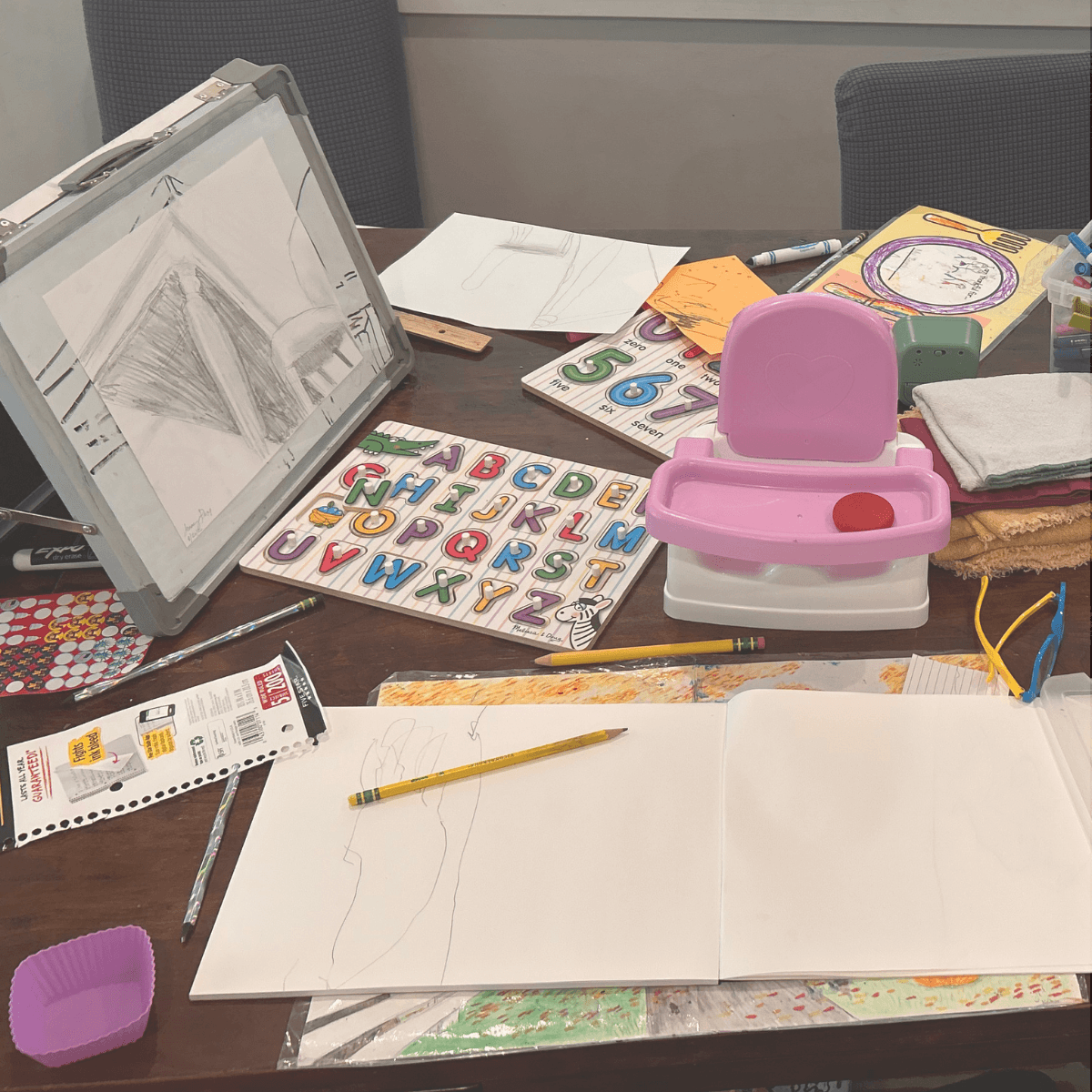
Are there toys sitting within your line of sight?
Is there a pile of papers nearby?
Are there interesting objects on the table?
Is the room visually cluttered?
Is the lighting too bright or too dim?
Is there a sound you hadn’t noticed—a buzzing light fixture, a loud appliance, a ticking clock, a dog barking outside?
Can you smell something strong, like a candle, air freshener, or food cooking?
None of these things might bother you.
But your child may be noticing all of them.
And if your child already has difficulty filtering out sensory information or directing their attention, those seemingly insignificant things can become much more significant.
That’s why one of the simplest focus strategies we can use is to audit the environment.
Not because we need a perfect environment.
But because we want to remove unnecessary distractions when we can.
A math manipulatives lesson taught me something
I remember one day sitting down with my son, James, to work on math.
We were using manipulatives, and I had put the entire bin of math manipulatives right on the table.
It seemed convenient.
Everything we might need was right there.
Except there was a problem.
James wasn’t just seeing the manipulatives we were using.
He was seeing the entire bin.
And suddenly all of those objects were competing for his attention.
He wanted to touch them.
He wanted to look at them.
He wanted to know what else was in the bin.
And what I had thought was helpful preparation was actually creating a whole lot of visual input.
That was a good reminder for me:
Having materials nearby is helpful. Having every possible material visible isn’t always helpful.
So now I try to prepare what we’re going to need before a lesson and keep it close by—but I don’t necessarily put everything out on the table.
I want the environment to say:
Here’s what we’re doing right now.
Not:
Here are 37 interesting things we could potentially do.
Less visual input can mean less work for the brain
This is something I think is particularly worth considering when homeschooling neurodivergent kids.
A cluttered environment isn’t automatically bad.
Some kids genuinely don’t care about clutter.
And some kids may actually prefer a certain amount of visual stimulation.
But if your child consistently gets distracted by what’s around them, it is worth experimenting with reducing the visual input.
You might try:
- clearing the table before beginning a lesson
- putting toys out of sight during focused work
- using a basket or bin to quickly collect distracting items
- keeping only the materials needed for the current lesson visible
- turning your child’s chair away from a particularly distracting area
- using a less visually busy part of the house for certain subjects
- keeping frequently used supplies nearby but out of sight
You don’t have to reorganize your entire house.
Try changing one thing and see what happens.
Don’t forget about lighting, smells, and sounds
When we think about distractions, we usually think about things we can see.
But our other senses matter, too.
Lighting
Is the overhead light harsh?
Is there enough natural light?
Is your child squinting or complaining about the lighting?
Try changing the location, opening blinds, turning off a light, or using a lamp.
Smells
Some children are particularly sensitive to smells.
A candle that smells wonderful to you might be incredibly distracting—or even unpleasant—to your child.
The same goes for air fresheners, cleaning products, essential oils, cooking smells, or other strong scents.
Sounds
Listen to the room.
Is there a fan running?
A refrigerator humming?
A light fixture buzzing?
Music playing?
A television in another room?
A dog barking?
Sometimes you become so accustomed to a sound that you don’t even notice it anymore.
Your child might.
Again, this isn’t about creating a completely silent homeschool.
It’s about noticing what might be competing for your child’s attention.
Set up before you start
Another simple way to reduce distractions is to prepare your materials ahead of time.
If every lesson begins with:
“Hang on, where’s the workbook?”
“Let me find the scissors.”
“I know I have those math blocks somewhere.”
“Wait, I need to print something.”
you’re creating opportunities for everyone’s attention to wander before you’ve even started.
When possible, gather what you’ll need ahead of time.
Put the math book on the table.
Have the pencil nearby.
Get the manipulatives ready.
Know which page you’re doing.
Then when your child sits down, you can actually begin.
But remember the lesson from my math manipulatives:
Prepared doesn’t have to mean everything is visible.
Keep what you need close.
Put away what you don’t.
And then there’s the sibling question…
If you’re thinking, Okay, but what am I supposed to do about my other children?
I know.
There are five opinionated people running around my house every day.
And doing life with other people is, by nature, distracting.
Siblings are going to talk.
They’re going to interrupt.
They’re going to argue.
Someone is going to need help.
Someone is going to make a ridiculous noise at exactly the moment you’re trying to explain something important.
And sometimes there will be hours lost to settling disputes, redirecting behavior, and doing all sorts of damage control.
I could give you a whole list of strategies for managing siblings during homeschool.
But honestly, I think that deserves its own conversation.
For now, I want to encourage you to look at your siblings not just as a distraction to manage, but as part of the education happening in your home.
Learning to live with other people is education, too
One of the reasons I love homeschooling is that our children don’t just learn academic subjects.
They learn how to live with other people.
They learn to negotiate.
They learn to communicate.
They learn to compromise.
They learn that other people have needs and opinions.
They learn to be patient.
They learn how to disagree.
They learn how to repair relationships.
They learn how to serve.
They learn how to work together even when they would really rather not.
And yes, sometimes that learning is exhausting.
But I think about the picture in Scripture of iron sharpening iron.
Sometimes our children are sharpening each other.
Not necessarily in the peaceful, Pinterest-worthy way we might imagine.
Sometimes it’s through conflict.
Sometimes it’s through frustration.
Sometimes it’s through learning to navigate a sibling who thinks completely differently from them.
And while I can absolutely get frustrated by the amount of time this takes, I don’t want to miss the fact that this is also education.
I know this personally, too.
I have a sibling with learning disabilities, and I would not be who I am today without the struggles, growth, and victories we experienced together as a neurodiverse family.
Those experiences shaped me.
They taught me things I couldn’t have learned from a textbook.
And that’s one reason I’m careful about thinking of our children’s differences—or their siblings’ differences—as simply obstacles to get around.
Sometimes they’re part of what God is using to shape all of us.
But we can still create a calmer environment
Recognizing that siblings are part of the learning doesn’t mean we have to make things unnecessarily difficult.
A calmer environment can support everyone.
Sometimes that means thinking about timing.
If you have older children, you might begin with your child who needs the most direct support.
Your older children may be able to work independently while you spend some focused time with your neurodivergent child.
And there’s another benefit:
Your younger or neurodivergent child gets to see their siblings working.
They get a model of what learning looks like.
If you have younger children, timing can be especially important.
For example, you might plan your more focused instruction after a meal or snack, when the younger child is more likely to be content.
You might set up an engaging activity in another area of the house.
Or you might give the younger child something that feels similar to what everyone else is doing:
- If you’re doing handwriting, give them paper and crayons.
- If you’re working with math manipulatives, give them their own age-appropriate manipulatives.
- If you’re reading, let them look through picture books.
- If you’re doing a hands-on science activity, give them a simple version they can participate in.
- If everyone is working at the table, give the younger child their own little work space.
It won’t always work.
Sometimes the toddler will still grab the marker.
Sometimes they’ll color on the bench.
Sometimes they will insist that they are also doing school.
And sometimes you just have to laugh.
Because this is homeschooling.
Want to get strategic?
Get this free done-for-you list of strategies you can implement to help everyone to be more focused in your homeschool:
You don’t need a perfect homeschool environment
I want to make sure this doesn’t turn into another list of things that make you feel like you’re failing.
You don’t need a dedicated homeschool room.
You don’t need a minimalist house.
You don’t need complete silence.
You don’t need every toy put away.
You don’t need to control every sensory input your child encounters.
And you definitely don’t need to spend your homeschool day constantly rearranging your house in an attempt to create the perfect learning environment.
Instead, start by noticing.
What seems to consistently distract my child?
Then experiment.
Move the toys.
Change the lighting.
Turn off the buzzing fan.
Put away the extra manipulatives.
Close the door.
Move to another room.
Try working outside.
Prepare your materials before the lesson.
Sometimes a tiny environmental change can make a surprisingly big difference.
And if it doesn’t?
Change it back.
We’re not trying to create a perfect environment.
We’re trying to create an environment that supports this particular child, in this particular season, in this particular homeschool.
That’s what homeschooling differently can look like.
You don’t have to homeschool like everyone else.
You just need to figure out what helps your child learn.